Provision a SIM, query usage, switch profiles, route an alert — every primitive is an HTTP call. Underneath: the same eUICC technology that's quietly become the default for cellular IoT, because the alternatives don't survive contact with a global deployment.
The cellular industry settled on the GSMA's eUICC standard for one reason: traditional removable SIMs and proprietary multi-IMSI workarounds couldn't meet the scale, lifecycle, or security requirements of modern IoT. EdgeUplink ships every customer on the standards-based path.
Operator profiles are downloaded and switched over the air per GSMA SGP.22. Add a network credential after a device has been deployed for years — no SIM swap, no recall.
Soldered MFF2 eUICC for sealed devices that need to last a decade. Removable nano-SIM still supported where field-replaceability matters more than form factor.
SGP.22 (consumer/IoT), SGP.32 (IoT remote provisioning), and conformance to MNO HLR / HSS / AuC security primitives. Not a proprietary stack you're stuck with.
Sign in at cloud.imatrixsys.com to see every eSIM in your account at a glance — ICCID, status, device serial, activation date, APN, and the carrier each SIM is currently attached to. Drill into per-zone usage, monitor monthly history, and suspend or reactivate SIMs from one place.
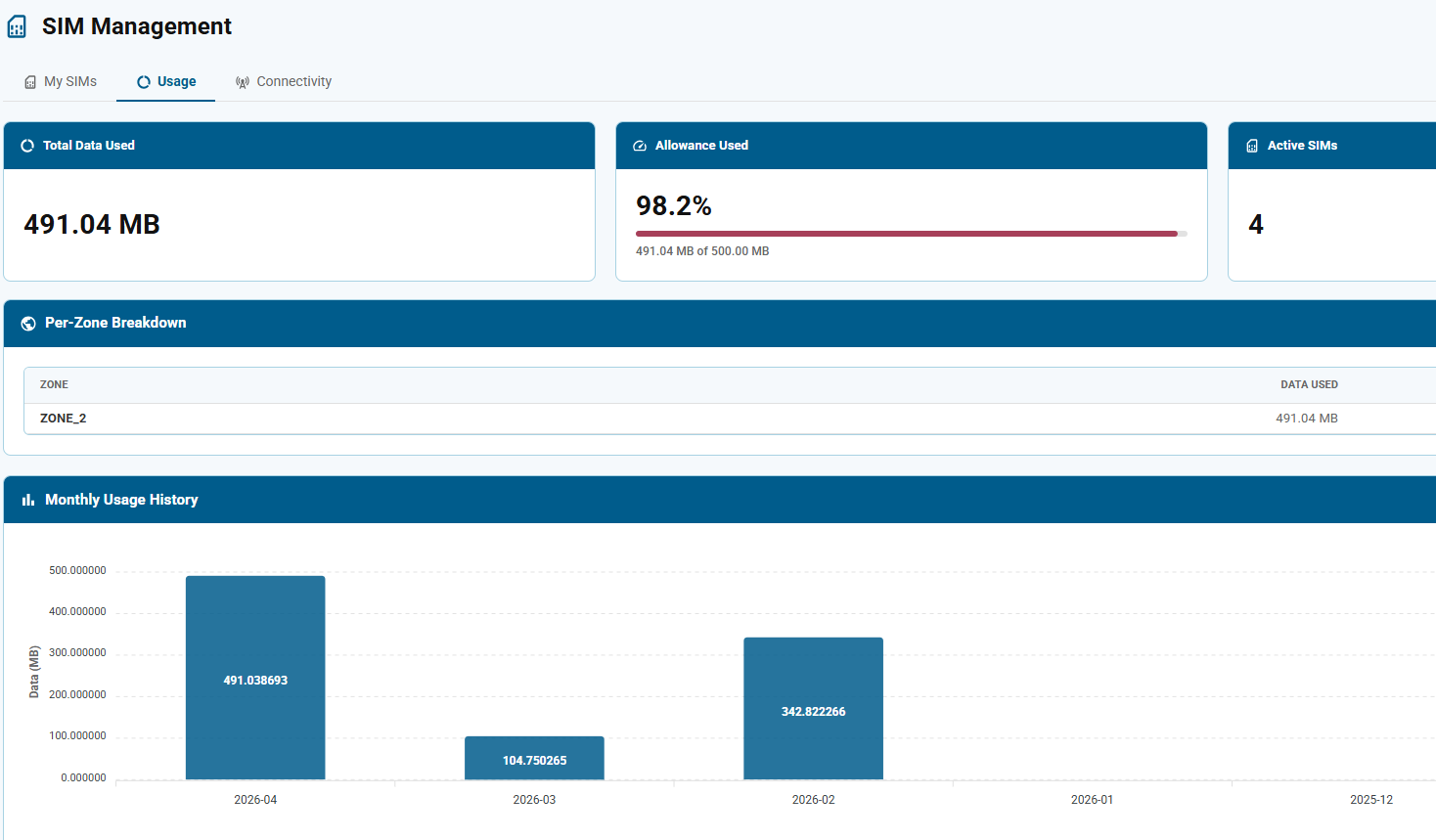
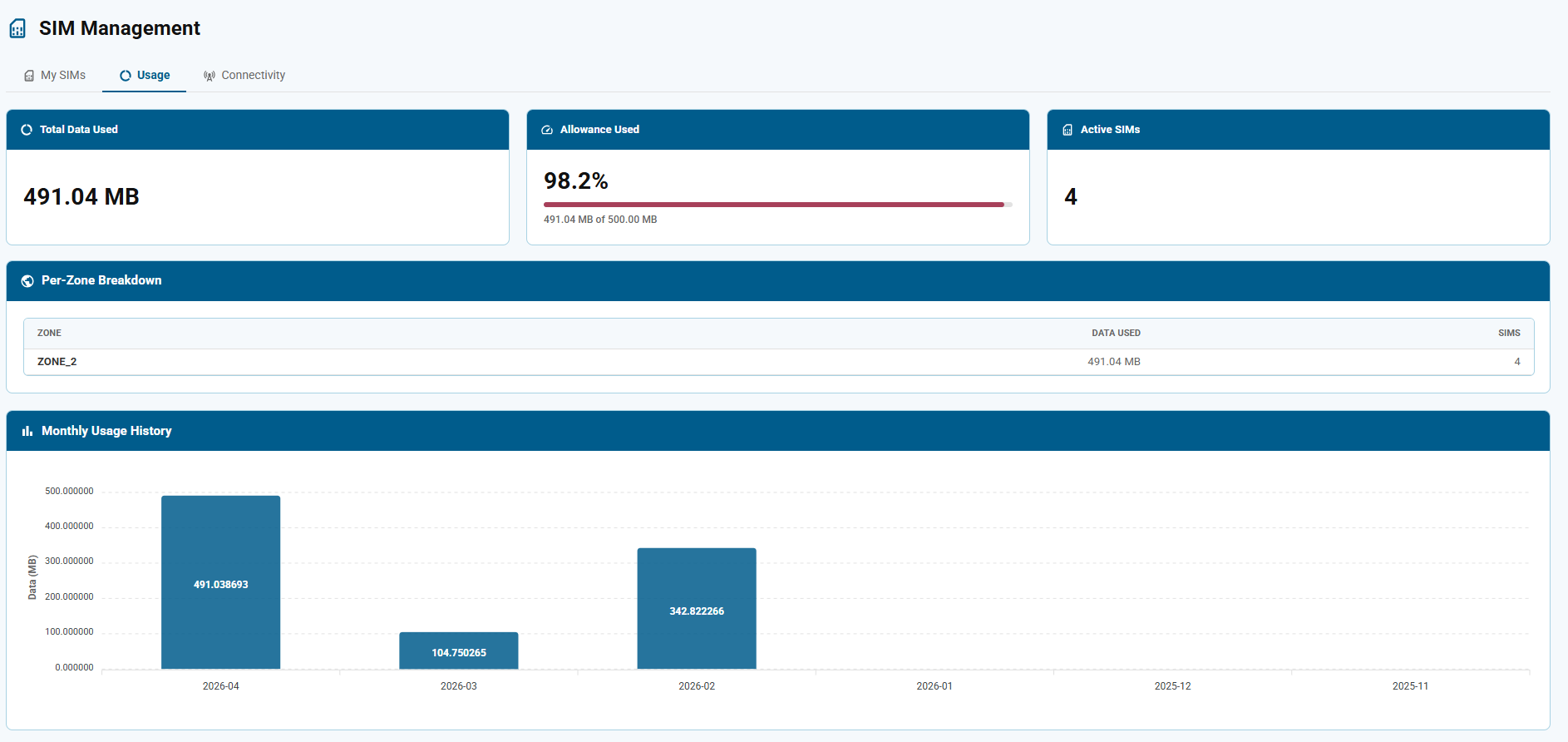

Same console powers iMatrix's own production fleet, environmental, and OEM device deployments.
Every IoT connectivity provider falls into one of three architectures. The differences aren't marketing — they're real constraints that show up at scale.
| eSIM / eUICC EdgeUplink |
Multi-IMSI legacy |
Roaming-only single profile |
|
|---|---|---|---|
| Profile selection | ✓ Positive logic — device authenticates against the chosen profile's home MNO | ~ Trial-and-error — the SIM cycles IMSIs until one attaches | ✗ One IMSI, one home network, fixed for the life of the SIM |
| Adding a new operator post-deployment | ✓ OTA download of new profile via SGP.22 | ~ Limited to the profile slots provisioned at manufacture | ✗ Requires physical SIM swap or rate-card renegotiation |
| Security model | ✓ Standards-based, MNO-grade key management, secure element on chip | ~ Often proprietary, varying levels of HLR / HSS integration | ✓ Strong, but limited to home-network credentials only |
| Local rate access | ✓ Local profile = local rate, no permanent roaming surcharge | ~ Some local credentials, but profile slots are scarce | ✗ Permanently roaming — exposed to wholesale rate hikes |
| Latency | ✓ Local data breakout near the device | ~ Variable — depends on which IMSI the SIM lands on | ✗ Centralized data routing — every packet hairpins through home |
| Future-proof against MNO changes | ✓ Add or remove operators over the air, indefinitely | ✗ Locked to manufacturer's MNO list | ✗ One contract change can strand a whole fleet |
Every profile event is an API call. No proprietary tooling, no network engineer on a phone call to a regional MNO. Provision, switch, suspend, and retire SIMs from a CI pipeline if you want to.
eSIM ships with a bootstrap profile that lets the device come online anywhere with cellular coverage on day zero.
iMatrix Cloud pushes a regional operator profile via SM-DP+ (Subscription Manager). Device authenticates against the chosen MNO.
Cross a border or change rate-card vendor? Trigger a profile switch from the API. The device re-attaches to the new operator.
Stolen device, end-of-life product, lost contract — flag the SIM and it's off the network within seconds. No truck roll.
Sign up for a free developer account, get test SIMs, and have your first device on the network this afternoon.